Breaking the Boxes

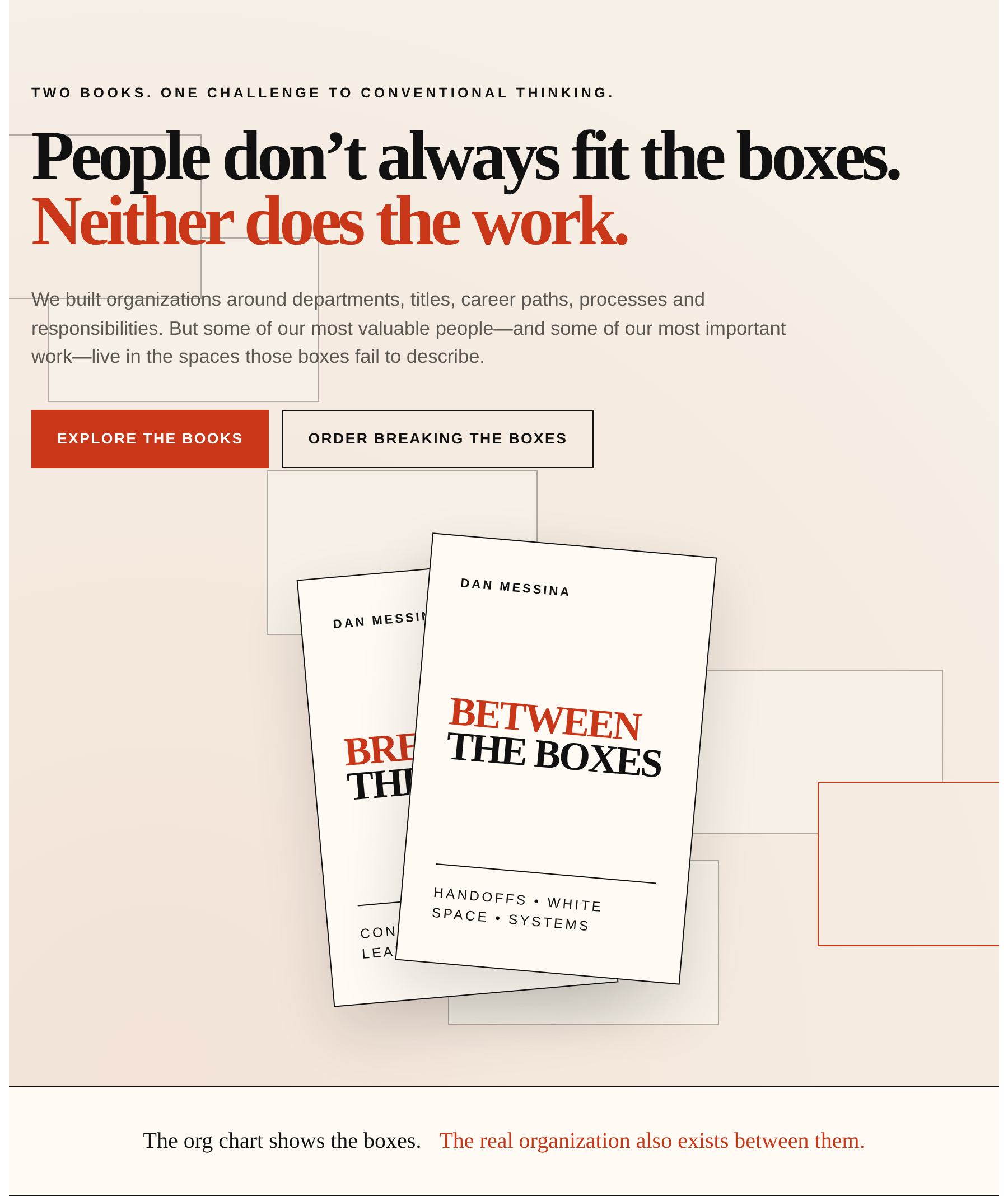
Most organizations say they want innovative thinkers, adaptable leaders, and people who can connect ideas across functions. But many of the systems we use to hire, develop, and promote people were built to do the opposite. We sort people into departments, titles, career tracks, job descriptions, and competency models, then wonder why collaboration is difficult and new ideas struggle to move across the organization. My theory of Breaking the Boxes starts with a simple idea: people are usually more capable than the boxes we put them in.

The traditional workplace was built around specialization. We created boxes because boxes made organizations easier to manage. Engineering did engineering. Sales did sales. Operations ran operations. HR handled people. Finance handled numbers. That structure still has value, but over time we began confusing organizational structure with human capability. A job title became shorthand for what someone could contribute, and a résumé became a list of boxes someone had occupied rather than evidence of what they had learned along the way.

That becomes a problem because many of the challenges organizations face today don’t fit neatly inside a department. Transformation, customer experience, innovation, continuous improvement, digital strategy, organizational change, and complex project leadership all require people who can move between disciplines. They require people who understand enough about several parts of the system to recognize relationships that specialists working within a single function may not see.

I call these people connectors.

Connectors may have unconventional careers. They may have moved between technical roles, operations, sales, project management, leadership, continuous improvement, or completely different industries. On paper, their experience can look scattered. In practice, that variety may be exactly what makes them valuable. They’ve learned to translate between groups, recognize patterns, ask questions outsiders are willing to ask, and connect ideas that normally live in different parts of the organization.

The problem is that most talent systems weren’t designed to recognize them.

We often hire by searching for the person who most closely matches the person who previously held the job. We ask for a certain number of years in a particular industry, experience with a specific title, or a career path that follows an expected progression. Those requirements can make recruiting easier, but they can also filter out the very people who might bring a different way of thinking to the organization. When every candidate has followed the same path, worked in the same industry, and solved the same kinds of problems, we shouldn’t be surprised when everyone sees the problem from roughly the same angle.

Breaking the Boxes means shifting the question from “Has this person done this exact job before?” to “What has this person demonstrated they can do?”

It means looking at capabilities instead of labels. Can they solve ambiguous problems? Can they earn trust across functions? Can they translate technical ideas into business language? Can they understand a system rather than only their piece of it? Can they learn quickly? Can they recognize connections others miss? Can they bring people together around a problem and help move an idea from conversation to execution?

This also changes how we think about career development. Careers rarely unfold as cleanly as organizational charts suggest. People change industries. They discover new strengths. Technology eliminates roles and creates new ones. Life interrupts plans. Sometimes people deliberately walk away from a path that no longer fits. Those experiences don’t necessarily weaken a career story. They can deepen it.

A person who has spent time in several different environments often carries lessons from one world into another. Someone who has worked in the field may understand how an executive decision actually lands on the shop floor. Someone who has worked in operations and sales may see both the customer's problem and the internal system required to solve it. Someone who has led continuous improvement and organizational change may understand that fixing a process and helping people adopt that process are two very different challenges.

Those intersections are where connector talent becomes especially powerful.

Breaking the Boxes isn’t an argument against expertise. Organizations still need specialists, and deep expertise matters. The point is that specialists and connectors solve different kinds of problems. Specialists often go deeper inside a discipline. Connectors move between disciplines and help the pieces work together. Healthy organizations need both.

The danger comes when we build an entire talent system around only one kind of value.

Breaking the Boxes is ultimately about expanding how we recognize human potential. Instead of asking people to spend their careers proving that they belong inside increasingly narrow boxes, organizations can create environments where curiosity, adaptability, range, and unconventional experience are treated as assets.

Because the next breakthrough may not come from the person who fits the job description perfectly.

It may come from the person standing between the boxes, seeing connections no one else thought to look for.